Most Australian homes have at least one space that makes you pause and think, “What on earth do I do with this?” Maybe it’s a narrow bedroom in a terrace house, a corner behind the door, or an attic room with a sloped ceiling that limits head height. These areas might seem impossible to use, but with thoughtful planning, they can become some of the most impressive and functional parts of a home. This is exactly where custom wardrobes in Sydney homes are often the most valuable, as standard solutions rarely suit these layouts.
At Silva Wardrobe, we’ve seen hundreds of examples where tricky layouts ended up becoming standout features once the right design was applied. If you’re dealing with an awkward room and feel stuck, you’re definitely not alone and the good news is, you have options.

These unusual spaces appear in homes all over Australia, from brand-new apartments to older Federation-style houses. The challenge isn’t just fitting a wardrobe into them; it’s creating something that functions well every day, doesn’t overwhelm the room and works with your lifestyle. That starts with recognising exactly what type of awkward space you’re dealing with.
Most awkward layouts fall into a few familiar categories. Corners, for example, often feel like wasted space because standard furniture rarely sits flush in them. Sloped ceilings in attic rooms reduce usable height and make hanging storage tricky. Narrow rooms, especially in inner-city apartments, can feel cramped if you bring in full-depth cabinetry.
While all these issues feel limiting, they’re also opportunities. With the right layout, awkward corners become walk-in wardrobe entrances, sloped ceilings become stylish feature walls with built-in cabinetry and tight rooms become smart, vertical storage zones.
If you’re planning storage for a difficult room, measuring properly is essential. A wardrobe that fits the space on paper might not function well when you’re actually moving around within it.
It helps to think about:
In older homes especially, walls aren’t always perfectly straight. Taking height and depth measurements at multiple points will give you a more honest picture of your space. Many homeowners also bring in professionals who use laser tools to map the room, which removes guesswork and prevents expensive fitting mistakes later.
Once you understand the shape of the room, it becomes much clearer which wardrobe style will work. A long, straight wardrobe makes sense in a narrow bedroom, but in a corner space, an L-shaped design might unlock twice the storage capacity.
Built-ins tend to be a favourite in awkward rooms because they can be shaped around unusual angles and alcoves. Sliding doors are excellent when there isn’t much floor space, while hinged doors are better if you want full visibility and fast access.
The more your wardrobe respects the way the space behaves, the more natural and comfortable the room will feel.
Once you start looking at wardrobe shapes through a problem-solving lens, awkward spaces become exciting to plan. The right structure can make your room look bigger, more balanced and more modern, while also solving long-term storage issues.
Corner wardrobes are one of the best-kept secrets in awkward room design. They allow you to use two adjoining walls, which adds depth without eating into valuable floor area.
In larger rooms, they can even form the entrance to a walk-in wardrobe. In smaller ones, they maximise hanging space in a part of the room that otherwise gathers dust. Many homeowners love the visual symmetry they bring, especially in square bedrooms where furniture along a single wall looks heavy or unbalanced.
If you’re solving storage problems in a very tight room, slimline wardrobes make a huge difference. These designs reduce depth but retain height and internal organisation, meaning you still gain excellent capacity while keeping your walkways clear.
In Sydney’s smaller apartments, shallow wardrobes running along a hallway or wall often provide storage without compromising comfort. It’s amazing how much space opens up once you reduce depth, even by ten centimetres.
Sloped ceilings are often seen as obstacles, but built-in cabinetry turns them into features. With a custom approach, the lowest parts beneath the slope can become drawers, shoe cabinets or shelving. Higher sections can house hanging compartments.
Alcoves are another gif;, once filled with tailored cabinetry, they look like the wardrobe was meant to be there all along. These solutions also remove awkward gaps that collect dust and clutter.
When you’re designing wardrobes for small rooms, the doors matter just as much as the internal layout.
Sliding doors make rooms feel calmer because nothing swings outward. They’re also ideal when the bed or desk sits close to the wardrobe. Hinged doors, however, give you full access to the interior, which some homeowners prefer because they can view everything at once.
The choice depends on how much clearance you have, your room shape and how you like to interact with your storage.
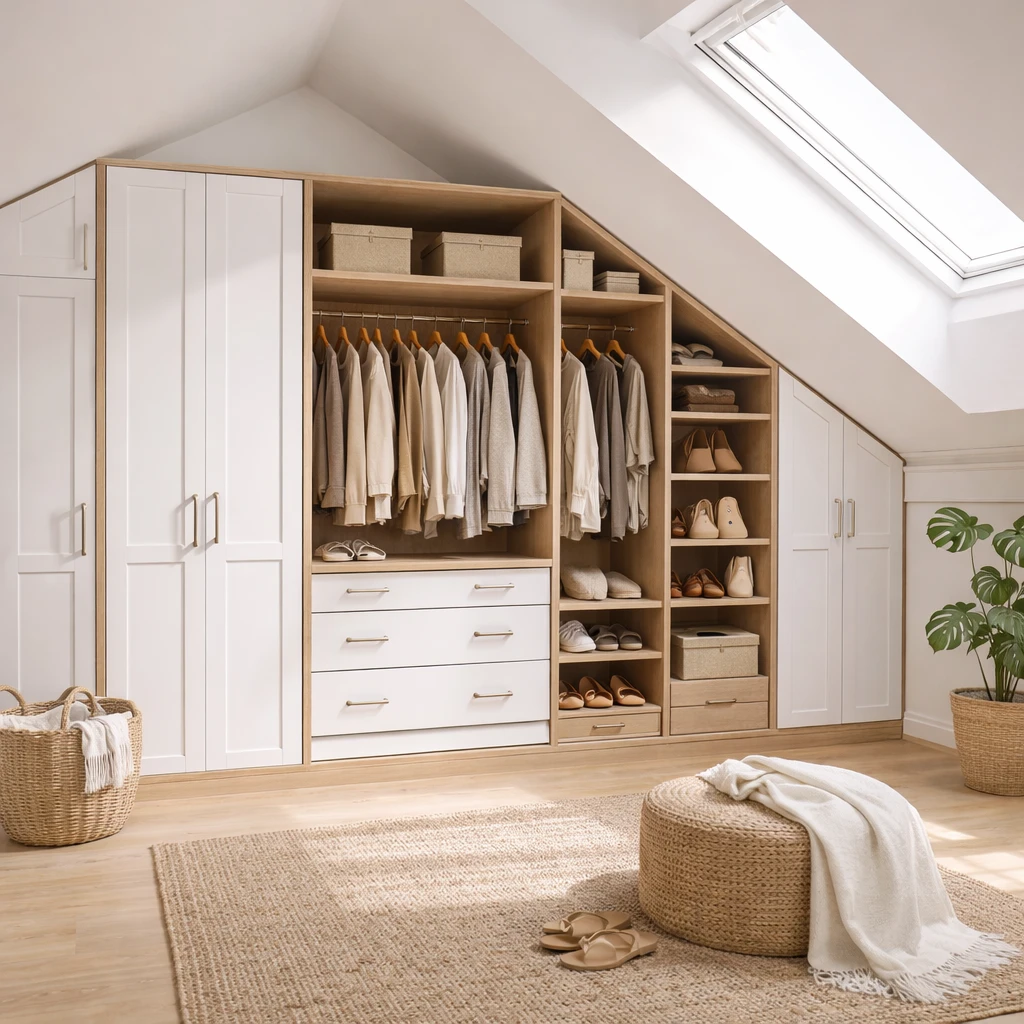
Once the wardrobe structure is planned, internal design elevates it. This is where awkward rooms can truly shine. The right mix of hanging space, drawers and lighting makes the wardrobe feel larger, easier to use and far more organised.
One of the smartest tricks for tight spaces is to build upward. Many homeowners don’t realise how much storage they gain simply by stacking elements: rail above rail, shelf above shelf.
Dual rails are fantastic for shirts, trousers and jackets, while tall sections keep dresses and coats in perfect condition. Adjustable shelves also let you tweak the wardrobe over the years, which matters for growing families or people who change their storage habits seasonally.
Pull-out solutions are brilliant in awkward spaces because they save you from bending and reaching into dark corners.
Dedicated shoe racks, velvet-lined trays, trouser slides and accessory drawers make organisation easier and help you maintain order long after installation day. These features turn an ordinary wardrobe into something that supports your daily routine.
Lighting dramatically improves wardrobes in awkward layouts. Without it, deep storage becomes frustrating, especially in alcoves or angled rooms.
LED strip lighting, recessed ceiling lights and motion-activated sensors brighten internal shelves and drawers so you can see everything clearly. Lighting also adds ambience and reduces morning struggle when you’re dressing early.
Rooms with awkward angles sometimes benefit from a mix of open and closed storage. Closed sections hide clothing and keep the wardrobe looking tidy, while open areas display bags, shoes or décor and make the cabinetry feel less heavy.
This mix is especially helpful in small bedrooms because it stops the wardrobe from dominating the room visually.
Awkward rooms don’t have to be wasted or frustrating. With the right design approach, they often become the parts of a home that feel most impressive and personal. Whether you’re working with corners, tight layouts or sloped ceilings, thoughtful wardrobe planning transforms limitations into beautiful features.
At Silva Wardrobe, we love helping homeowners reshape tricky layouts into fully functional storage solutions, especially for people looking for custom wardrobes in Sydney and surrounding suburbs. With the right blend of planning, structure, internal features and creativity, every difficult space truly can work in your favour.
Here at Silva Wardrobes, we believe that you shouldn't have to compromise on quality when you’re on a budget. We offer a wide range of built in wardrobe designs in varying materials and finishes, so you can get the perfect built in or walk in wardrobe for your home no matter what the budget you're working with.
Proudly Australian owned and made. All our work is carried out locally in Sydney with only the highest level of craftsmanship and comes with a lifetime guarantee.

Contact us for a free measure and quote in the Sydney metropolitan area. We send out a qualified tradesman, not just a salesman.

We then create all the components to your perfect built in wardrobe to exact specifications using only the highest quality materials

A wardrobe technician will then deliver and install your wardrobe ensuring you are 100% happy with the job before they leave.


