Modular wardrobe design is transforming how people use and enjoy their storage, turning cramped cupboards and cluttered rails into calm, efficient spaces that work around everyday life. Silva Wardrobe focuses on creating built in wardrobes in Sydney that are not only beautiful to look at but also carefully planned to maximise every centimetre of space. By combining flexible internal layouts with smart organisational details, modular solutions help clients achieve a wardrobe that feels tailored to their routine rather than forcing them to adapt to a fixed interior.
In this article, we explore how modular components such as adjustable shelving, varied hanging zones, pull-out accessories and integrated drawers can improve capacity and organisation. Readers will discover how to configure interiors for different room sizes and ceiling heights, how to future-proof storage for changing needs and how considered design details reduce visual clutter while making daily dressing faster and more enjoyable. The aim is to share clear, practical insight so anyone planning a new wardrobe or upgrading an existing one can make confident design decisions that deliver long-term order and a more streamlined home.
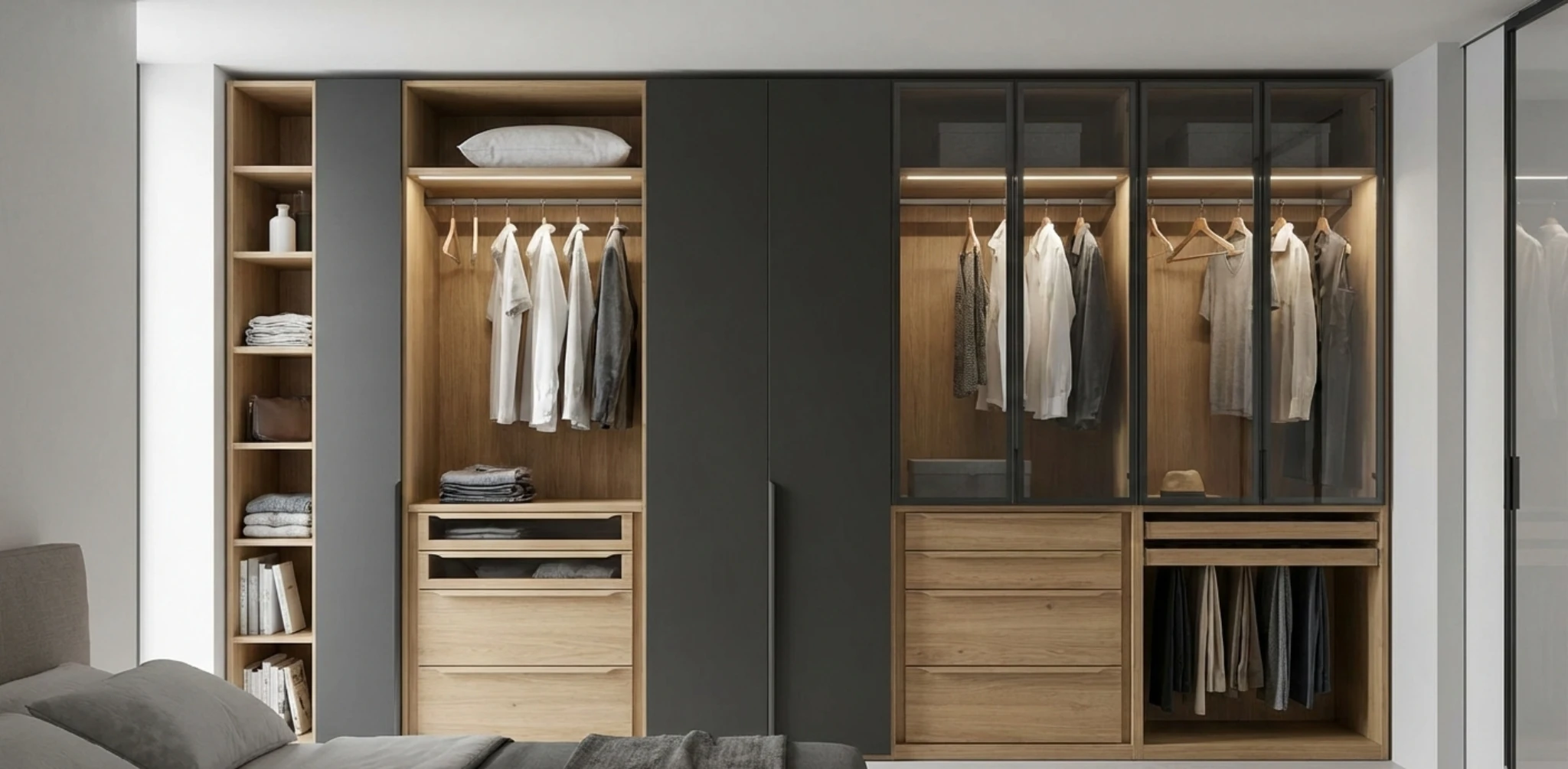
Modern homes often have to balance limited floor space with growing storage demands. A modular wardrobe offers a flexible, space‑efficient answer that can be tailored to different room sizes, ceiling heights and lifestyle changes. Rather than being fixed around a single layout, modular systems let homeowners design internal storage that matches what they actually own and how they prefer to organise it.
More clients are looking for wardrobes that can evolve with them. Modular designs make it easy to reconfigure shelves, rails and drawers as needs shift from single living to sharing a space or from office wear to family storage. This adaptability is what makes modular wardrobes particularly suited to modern living.
The main advantage of a modular wardrobe is that it can be reconfigured without replacing the entire unit. Internal sections are designed as interchangeable modules, allowing hanging rails, shelves, drawers and accessory inserts to be moved or swapped as needs evolve.
For example, a client might begin with more hanging space for workwear. Over time, that same section can be adjusted to include extra shelving for folded knitwear or storage boxes. With a modular interior, a long hanging section can be converted into a mid-height rail with shelving above and below, all within the existing carcass. This reduces waste and avoids the cost and disruption of a full refit.
Families benefit from this flexibility as well. As children grow, short hanging areas can be adapted into full-length sections, and shallow shelves used for toys can be replaced with deeper shelves or drawers for clothing. Modular systems make these adjustments straightforward and cost-effective, keeping the wardrobe aligned with changing routines and storage needs.
City homes and compact properties rarely have the luxury of unused space. Modular wardrobes are designed to work tightly with the dimensions of a room, including awkward areas that standard freestanding furniture cannot use efficiently.
Customisable carcass sizes and internal modules allow experts to:
Inside the wardrobe, adjustable shelves can be set to precise heights for shoes, bags or storage boxes. Double hanging sections take advantage of full ceiling height in bedrooms with higher walls, while pull‑out trouser racks and shoe trays use the lower part of the wardrobe that often becomes cluttered in non‑modular designs.
Modern households need storage that supports fast daily routines. Modular wardrobes allow internal layouts to be planned around how items are used rather than simply where they can fit.
Closet consultants often design sections with clear zoning, such as:
Drawer dividers and accessory trays prevent smaller items from being lost at the back of a shelf. Pull‑out mirrors, internal lighting and soft‑close drawers add to the sense of order and ease. Because everything has a defined place, it is easier to keep the wardrobe tidy, find outfits quickly and keep surfaces around the room free from clutter.
Modular wardrobes earn their value through thoughtful details that make the most of every centimetre. The right combination of rails, shelves and internal fittings can transform an awkward alcove or compact bedroom into a highly organised dressing area.
Well-considered design features allow the interior to adapt to different clothing collections, room dimensions and ceiling heights. When planned properly, a modular wardrobe works hard every day, not just visually on the outside, but through practical internal layouts that increase usable storage and reduce clutter.
Flexible hanging space is one of the biggest gains with modular design. Double hanging rails for shirts, blouses and folded trousers immediately increase capacity compared with a single full‑height rail. A shorter section with a full‑length rail is then reserved for dresses, coats and long garments, so nothing drags on the floor.
Adjustable shelves are equally important. Pre‑drilled side panels allow shelves to be moved up or down as wardrobes change. For example, shelves can be spaced closely together for T‑shirts and knitwear or opened up to store bulky jumpers or storage boxes. Professionals combine open shelves at eye level with deeper shelves higher up for items that are used less often, such as occasionwear or spare bedding.
Pull‑out hanging frames are another space saver in narrow rooms. These bring clothes out towards the user, which is ideal where there is limited clearance in front of the wardrobe.
Internal drawers make use of the most accessible zone between waist and chest height. Shallow soft-closing drawers are ideal for underwear, accessories and folded tops, while deeper drawers accommodate jeans or knitwear that would otherwise topple from open shelves. Positioning these drawers inside the wardrobe removes the need for a separate chest, freeing up valuable floor space.
Vertical dividers prevent tall shelf spaces from becoming cluttered or underused. Slim partitions can transform a single wide shelf into organised sections for bags, clutches or neatly stacked shoe boxes. In wider modules, combining cubby-style compartments with open shelving ensures handbags, hats and folded garments each have a defined place.
Drawer inserts such as jewellery trays, watch pads and belt organisers further refine the interior, ensuring every centimetre is purposeful rather than wasted.
Good modular wardrobes treat corners and high spaces as useful storage, not dead zones. Corner hanging units with angled rails allow garments to slide right back into the corner, so there are no unreachable gaps. In very tight corners, open shelving can be used instead, which is better for bags, shoes or folded linens.
The space above the main hanging area is ideal for overhead cupboards. Designers often suggest full‑width top units for suitcases, out‑of‑season clothing or spare duvets. Fitted doors keep this higher storage dust-free and visually tidy, while push‑to‑open mechanisms avoid the need for protruding handles in smaller rooms.
Pull‑down hanging rails are an option for particularly tall installations. These rails bring the top level of hanging within easy reach, so the full wardrobe height can be used even in rooms with high ceilings.
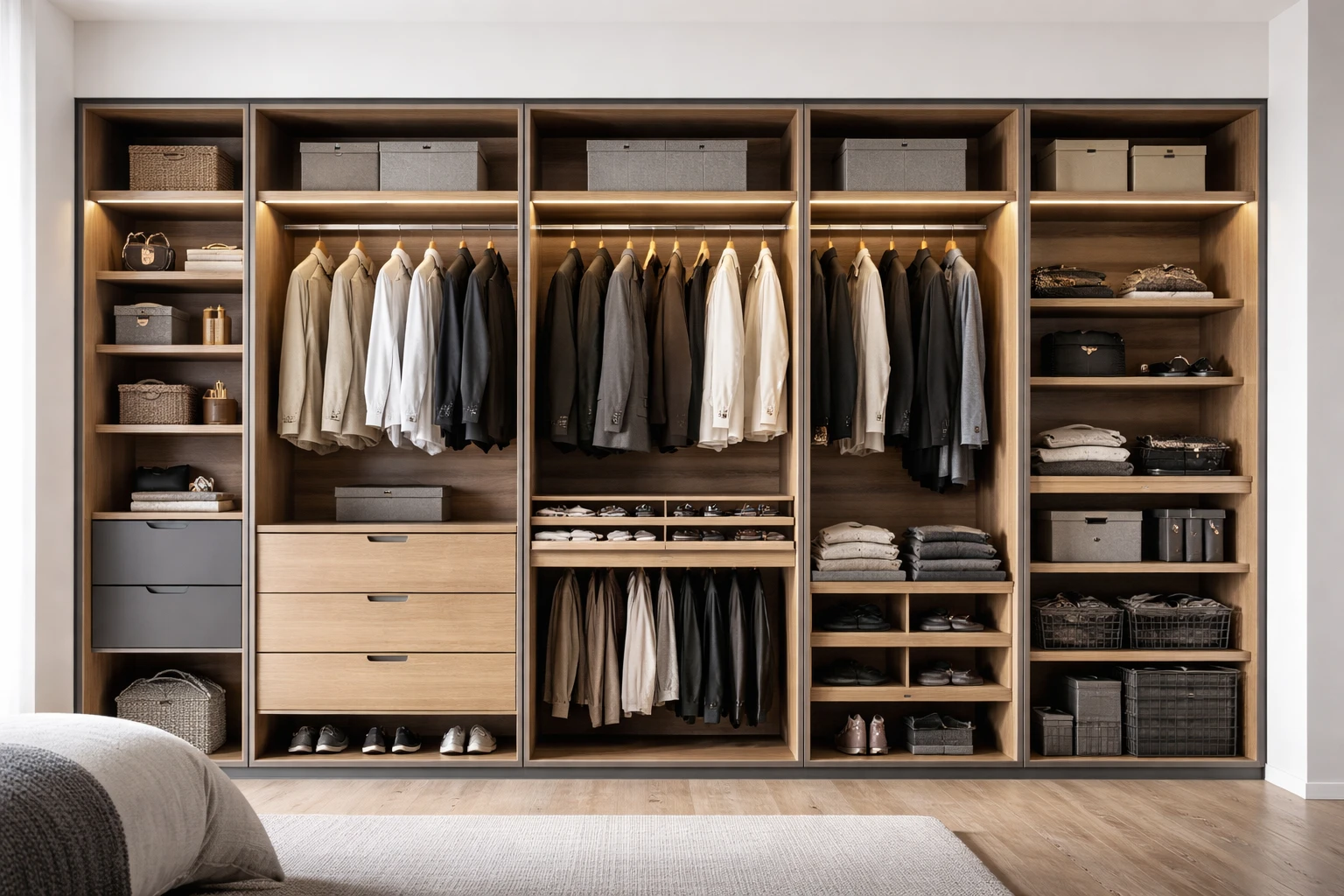
Planning comes before purchasing when it comes to modular wardrobes. A well-thought-out layout makes every centimetre work harder, so clothes are easier to find and the space feels calm rather than cluttered. Planners encourage customers to treat this stage like a mini space audit that balances what needs to be stored with how the room is used day to day.
Instead of starting with modules or finishes, it is more effective to start with measurements and habits. Once the footprint height and storage priorities are clear, it becomes straightforward to slot in the right mix of hanging space, shelves and drawers in a way that feels tailored rather than generic.
The first step is to measure the full height, width and depth of the proposed wardrobe area, including any alcoves, sloping ceilings or boxed-in pipework. It helps to note the positions of doors, windows, plug sockets and radiators, as these affect where doors and internal modules can sit.
Next, it is important to audit what will actually live in the wardrobe. Experts suggest grouping items into categories such as:
Estimating how much rail length and shelf space each category needs prevents the all too common mistake of too much hanging and nowhere to put folded or small items.
A modular layout works best when it reflects how often items are used. Everyday clothing should sit between shoulder and hip height, where it is most accessible. Less-used pieces can move higher or lower, so prime space is reserved for what is needed most.
Closet designers often recommend:
Drawer modules are best placed at waist to hip height so contents are visible when opened. Very low sections can be kept for shoes in pull-out trays or open shelves, which keep pairs together and visible.
With zones defined, the internal components can be selected more precisely. Hanging rails should typically allow 90 to 100 cm for long garments and around 90 cm for short hanging to prevent bunching. Adjustable shelves work well for stacks of knitwear, denim and bags, as the spacing can be changed if wardrobes evolve.
Soft-close drawers help keep smaller items ordered, especially when combined with dividers for underwear, belts and jewellery. Pull-out accessories such as tie racks, trouser racks and scarf rails are useful in narrow runs where traditional shelves would be awkward to reach.
The right combination of materials and hardware can make a modular wardrobe feel more spacious, smoother to use and easier to keep organised. Beyond appearance, every shelf board, hinge and handle influences how much weight the wardrobe can support, how quietly it operates and how well it performs over time.
Careful material selection balances durability with a clean, modern aesthetic. When chosen thoughtfully, finishes and fittings ensure the wardrobe works hard every day without looking cluttered or dated, maintaining both function and visual clarity for years to come.
The core board is the backbone of any modular system. For most bedrooms, high‑density melamine‑faced board is ideal, as it is cost-effective, resists scratches and wipes clean easily. It suits shelving, hanging sections and drawer carcasses where consistent colour and low maintenance are priorities.
For heavier use or large spans, such as wide shelving units or tall cabinetry, experts recommends moisture‑resistant MDF or plywood. These options hold screws more securely and are less prone to sagging, which is important for long hanging rails or deep storage cubes.
Glass is used selectively to improve visibility and reduce visual bulk. Frosted or clear glass fronts on key sections let users see shoes, accessories or folded items without opening every door, which speeds up daily routines and helps maintain order. Mirror fronts are particularly effective in small rooms, as they eliminate the need for a separate full‑length mirror and visually expand the space.
Quality hardware is what makes a modular wardrobe feel premium and functional. Soft‑close hinges and drawer runners prevent slamming, reduce noise and protect fronts from impact, which is valuable in shared or compact bedrooms. Full-extension drawer runners are especially important, as they allow access to the entire drawer depth, so nothing gets lost at the back.
Sturdy metal hanging rails are essential for maximising hanging capacity. Oval or reinforced rails hold more weight and flex less, which allows longer spans without extra supports that break up the storage. Pull‑down hanging mechanisms are a smart option for high ceilings, as they bring upper rails within reach and turn otherwise wasted vertical space into everyday storage.
Internal accessories, such as pull‑out trouser racks, tie trays, jewellery organisers and shoe drawers, help divide space precisely. These components keep small or awkward items contained, so shelves can be shallower and more numerous, which increases usable storage without making the wardrobe feel bulky.
Finishes affect maintenance and how spacious a wardrobe feels. Light neutral melamine or lacquered finishes reflect more light, which helps compact rooms feel open and makes it easier to see items inside. Matt or low‑sheen surfaces reduce fingerprints and minor scratches, so the wardrobe looks tidy with minimal cleaning.
Edge banding on all visible and high-wear edges is vital. It protects the core material from moisture, chips and knocks, and gives doors and shelves a solid finished look. For door and drawer handles, experts favour slim recessed pulls or integrated handle profiles, which reduce visual clutter and avoid protrusions that steal space in narrow rooms or along passageways.
A modular wardrobe is designed to evolve as life changes. Instead of a fixed interior that works for a few years and then becomes cramped or awkward, modular systems can be reconfigured, expanded or simplified, so the same wardrobe keeps working whether the user is building a workwear collection, sharing space with a partner or making room for children’s belongings.
By combining adjustable shelves, interchangeable hanging options and add‑on units, a modular wardrobe allows storage to be reshaped without ripping out and replacing the whole system. This saves space and cost while keeping the interior organised and easy to use.
One of the advantages of modular wardrobes is the ability to adjust the internal layout when clothing types or quantities change. Hanging rails can be moved higher or lower or swapped from full‑length to double‑hanging to respond to a shift from long dresses to shirts and separates. Shelves can be repositioned to fit bulkier knitwear in winter, then tightened up to hold smaller folded items in summer.
Skilled professionals can design interiors around adjustable side panels with multiple fixing points. This means a section that starts as a tall hanging space can later be converted into a combination of drawers and shelves without replacing the entire carcass. Drawer modules can be added beneath an existing rail for lingerie or activewear, while pull‑out trays can replace static shelves to make small accessories easier to see and reach.
For shared wardrobes, the layout can change when one person needs more space. A bank of shelves on one side can be converted to additional hanging for a growing work wardrobe, while folded items move into new drawers or overhead compartments.
Storage needs rarely stay the same throughout life, and a modular wardrobe can adapt to each stage. In a nursery, the interior might start with more shelving for baskets of baby clothes and linen. As the child grows, experts can replace some shelves with lower-hanging rails so children can reach their own clothes and school uniforms.
When a spare room becomes a home office, part of the wardrobe can be refitted with deeper shelves for files and boxes while retaining a section for hanging clothes for guests. Later, if the room returns to full bedroom use, those shelves can convert back to clothing storage using the same framework.
Modular interiors also suit downsizing or decluttering. If a customer moves to a smaller home, taller units with more vertical organisation, such as extra top shelves or stacked drawers, can create the equivalent capacity of a larger previous wardrobe within a tighter footprint.
A well-designed modular system can grow along with the collection. If more space is needed for shoes, a standard hanging section can be updated with pull-out shoe racks or angled shelves instead of buying a separate shoe cabinet. Open compartments can gain doors or drawer fronts to create a cleaner look as the household’s style evolves.
Modular systems often use standardised module widths and fixings, so new components can be added to existing carcasses after several years. Customers might bolt on an extra tower unit at one side for seasonal storage or integrate specialised inserts such as tie or jewellery organisers as their needs become more specific.
By allowing targeted upgrades rather than full replacements, a modular wardrobe offers a long service life while keeping organisation closely aligned with how the space is actually used at every stage.
Everything explored comes back to one simple idea: a well-designed modular wardrobe should work as hard as you do. With careful planning of internal layouts and a considered mix of hanging space, shelving, drawers and accessories, even awkward corners and full-height walls can be transformed into organised, efficient storage.
Thoughtful material choices, flexible components and future-proof features allow the wardrobe to adapt as your lifestyle, family and clothing needs change, without requiring a full replacement. Integrated lighting, well-designed door systems and tailored interiors ensure every centimetre is both practical and visually refined.
When modular design is approached with long-term usability in mind, a wardrobe becomes more than storage. It becomes a structured system that supports daily routines, reduces clutter and adds lasting value to the home.
Here at Silva Wardrobes, we believe that you shouldn't have to compromise on quality when you’re on a budget. We offer a wide range of built in wardrobe designs in varying materials and finishes, so you can get the perfect built in or walk in wardrobe for your home no matter what the budget you're working with.
Proudly Australian owned and made. All our work is carried out locally in Sydney with only the highest level of craftsmanship and comes with a lifetime guarantee.

Contact us for a free measure and quote in the Sydney metropolitan area. We send out a qualified tradesman, not just a salesman.

We then create all the components to your perfect built in wardrobe to exact specifications using only the highest quality materials

A wardrobe technician will then deliver and install your wardrobe ensuring you are 100% happy with the job before they leave.


