For many homeowners, the challenge with walk in wardrobes in Sydney is not always the amount of available space, but how effectively that space is designed. As wardrobe specialists, Silva Wardrobe regularly works with awkward corners, unused box rooms and compact alcoves that can be reconfigured into efficient small walk in wardrobes when planned correctly. With careful layout design and internal configuration, even a modest footprint can provide substantial storage without feeling cramped.
This article explores how strategic layout planning, tailored joinery and smart internal storage solutions allow small walk in wardrobes to feel organised and balanced. Readers will learn how to combine hanging space, shelving and drawers effectively, how lighting and accessories improve usability, and how thoughtful design decisions help tight dimensions work harder while maintaining comfort and flow.
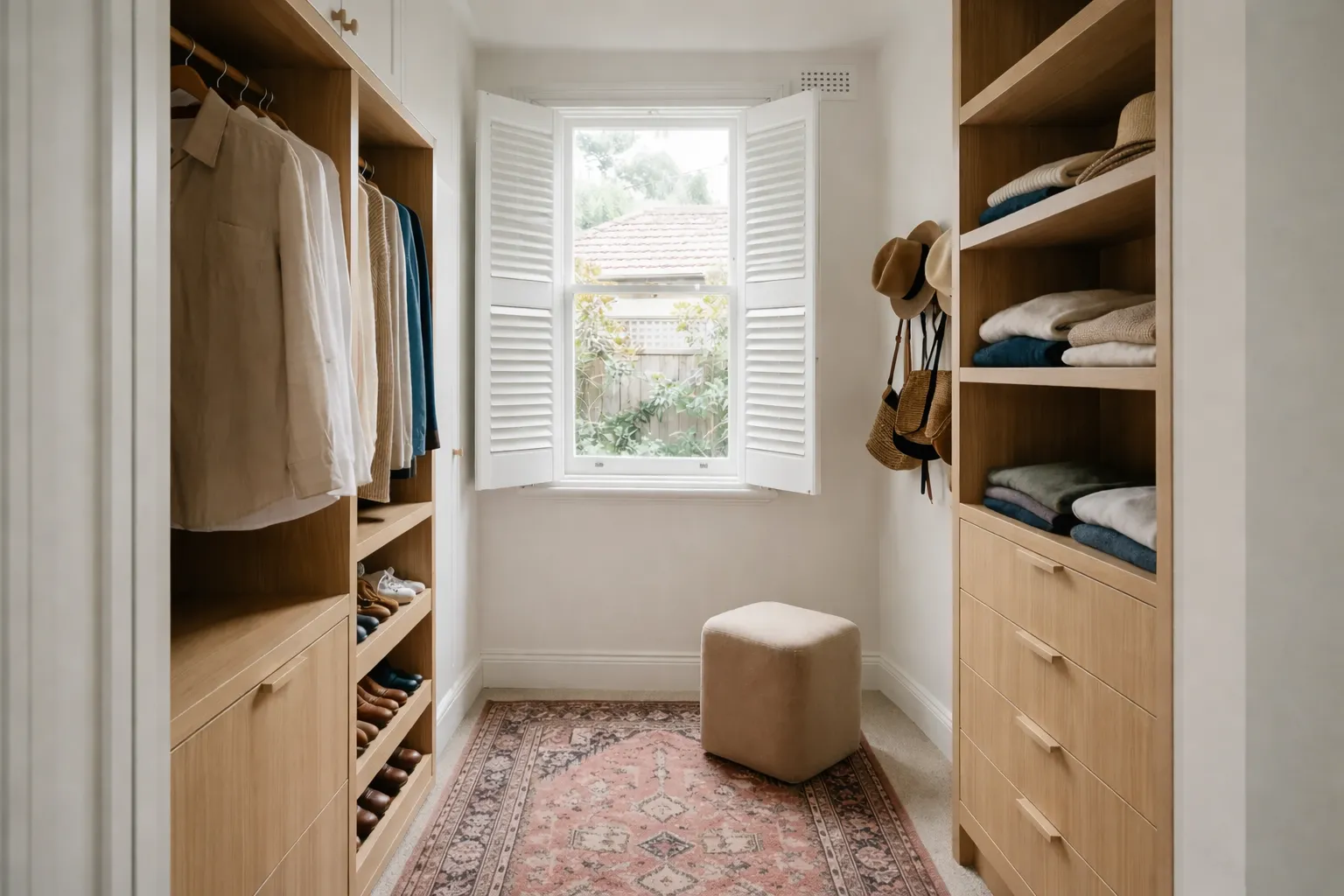
Small walk in wardrobes are becoming more common as homeowners look for smarter ways to improve storage within the footprint they already have. Rather than relying on freestanding wardrobes or standard built-ins, many are choosing compact walk in layouts that create a dedicated storage zone inside an existing room.
When carefully planned, a smaller walk in can often store more than a traditional fitted wardrobe because it makes better use of full height, corners and internal zoning. It also keeps clothing and accessories separate from the main bedroom, helping the space feel calmer and less cluttered.
As expectations around organisation and interior design continue to rise, homeowners are rethinking box rooms, alcoves and underused corners. A compact walk in offers a practical way to turn these areas into functional storage without extending or reconfiguring the entire home.
As newly built homes get smaller and many people choose to stay in their properties longer rather than move, every square metre has to work harder. A small walk in wardrobe allows homeowners to create a dedicated storage zone without sacrificing an entire room.
Instead of squeezing freestanding wardrobes into a bedroom and still lacking hanging space, a compact walk in along one wall or tucked into a corner can make full use of ceiling height and awkward recesses. This suits busy households where clothes, shoes and bags need to be visible and easy to grab on workdays or school mornings.
Hybrid working has also shifted how rooms are used. A space that once functioned purely as a guest bedroom may now double as a home office while still accommodating a neatly planned walk in along one side. Clients are increasingly open to rethinking box rooms and transitional spaces, and a small walk in is often the most practical way to turn those areas into something genuinely useful.
Homeowners increasingly want storage that feels calm and organised rather than crammed. A small walk in wardrobe separates clothing and accessories from the main bedroom, helping the sleeping space feel more restful and visually uncluttered.
Inside the walk in, open shelving, shallow drawers and double hanging rails can be arranged so everything remains visible and accessible. This reduces clutter on chairs and floors and makes it easier to see what is actually worn. Simple additions such as integrated lighting, matching hangers and a well-placed mirror create a boutique feel even in a narrow space.
Social media and home improvement programs have also raised expectations. People see beautifully organised dressing spaces and want a realistic version that suits a typical Sydney home, whether that is a compact inner-city terrace, a suburban family property or an apartment. A well-designed small walk in delivers that experience without requiring the footprint of a full dressing room.
For many homeowners, storage becomes the primary source of frustration long before space itself runs out. Moving house or building an extension is often expensive and disruptive, particularly when the core issue is simply poor internal storage.
A small walk in wardrobe can offer a more practical solution. With made-to-measure cabinetry, even a compact footprint can provide:
This level of organisation often reduces the need for additional bedroom furniture, which can make the entire room feel more open. A well-designed walk in may also improve perceived value, as dedicated dressing space is widely viewed as a desirable feature in modern homes.
In a small walk in wardrobe, every centimetre must work hard. The right layout can double the effective storage without making the room feel cramped and can turn an awkward box into a calm, organised space that is easy to use every day.
Most wardrobe specialists focus first on how the space will be used, then build a layout that layers hanging shelving and drawers vertically. By planning zones around the user’s habits, it becomes possible to store more while keeping everything visible and within easy reach.
The starting point is always the floor plan. For a narrow walk in wardrobe, a single run or galley layout with hanging on one wall and shallower shelving or hooks on the opposite wall maintains a clear central walkway. In slightly wider rooms an L-shaped layout uses two adjoining walls for storage while leaving the open side for movement and a mirror.
For compact square rooms, a three-wall or U-shaped layout often works best. Most wardrobe specialists typically keep the back wall for full-height hanging or a feature section such as a central drawer tower with shelving above, then use the side walls for a mix of double hanging and shelves. The key is to maintain a comfortable standing space in the centre so doors and drawers can open fully without obstruction.
Corner areas are easy to waste, so corner hanging rails or wraparound shelving help avoid dead zones. Alternatively, the corner can be left for tall shelves used for less-accessed items such as occasional shoes or luggage.
Hanging space is usually the biggest requirement, so it needs to be cleverly layered. In most small walk ins, wardrobe specialists recommend double hanging on at least one wall with rails at roughly 1000 mm and 1900 mm for shirts, jackets and folded trousers. This instantly gives two levels of storage in the footprint of one.
Single full-height hanging should be limited to one narrower section for long dresses, coats or gowns. Placing this towards a corner reduces its impact on the rest of the layout. Above all, hanging rails and a top shelf up to ceiling height provide valuable storage for out-of-season clothing or bulky items in labelled boxes.
Pull-down hanging rails can be added where ceilings are high and the user is shorter so the highest sections still remain practical. This allows vertical space to be used without compromising everyday access.
Drawers are ideal in small walk ins as they condense folded items into a compact footprint and minimise visual clutter. Shallow drawers at waist height work well for underwear, belts and accessories, while deeper drawers lower down store knitwear or gym gear. Open shelves above drawers are useful for stacks of jeans or handbags that are easier to grab when visible.
Shelving depth should be matched to the item. For shoes, 300 mm is usually enough and prevents pairs from being lost at the back. For folded clothing, most wardrobe specialists often use 350 to 400 mm deep shelves to balance capacity with visibility. Adjustable shelves mean the layout can evolve as wardrobes change.
In very tight spaces, sliding doors on cabinetry reduce the clearance needed and slim pull-out accessories like trouser racks or shoe trays use narrow gaps that would otherwise be wasted. Hooks on end panels or behind the door create quick-grab spots for bags, robes or tomorrow’s outfit without crowding the main storage runs.
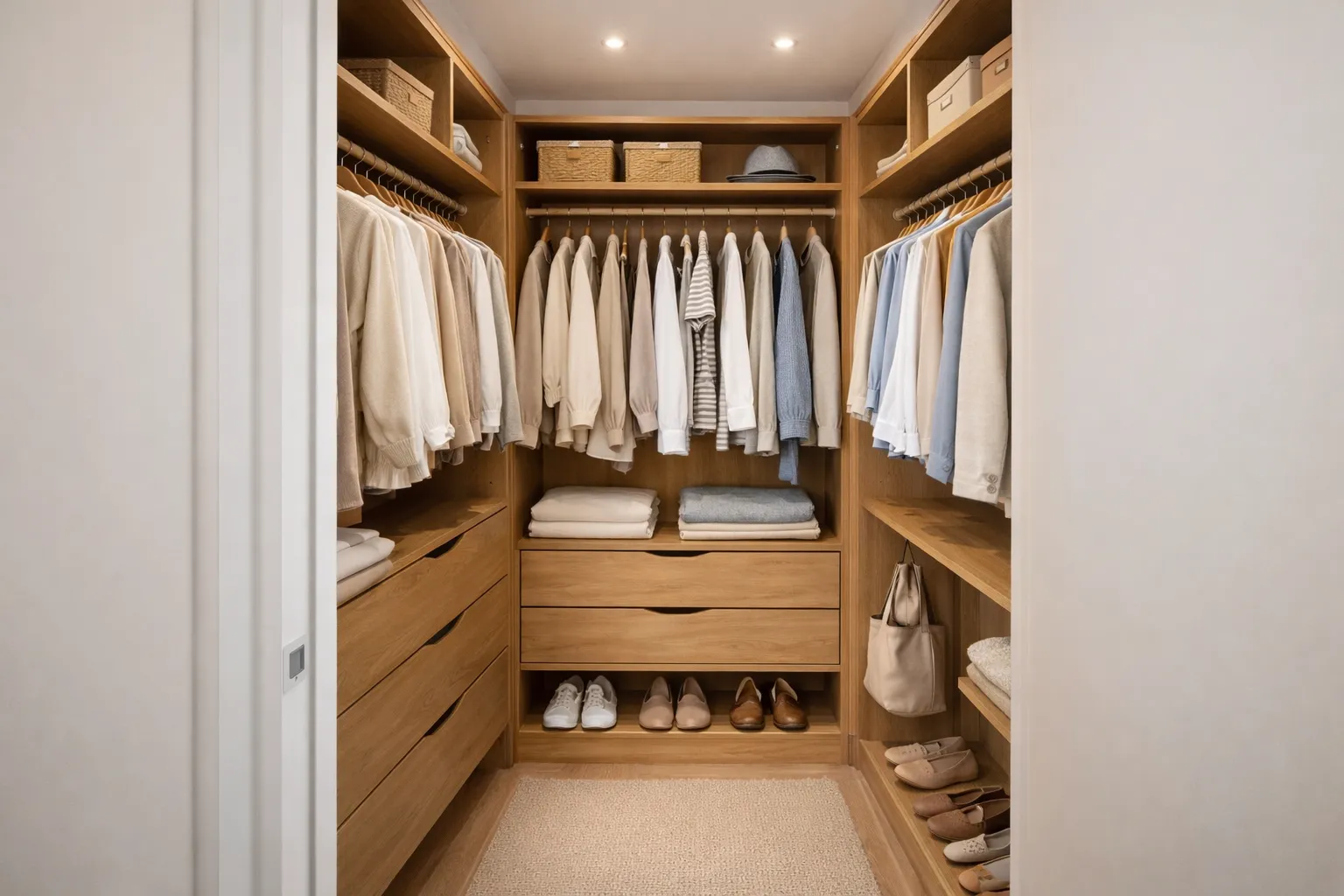
A small walk in works best when every item has a clearly defined place. Rather than filling the walls with unplanned rails and shelves, it is more effective to create simple storage zones that reflect how the space is used each day. This approach keeps the wardrobe organised and makes getting dressed quicker, as frequently worn pieces are always within easy reach.
Zoning involves grouping clothing by type and by frequency of use, then allocating each group to the most practical height and storage format. When planned carefully, even a compact footprint can feel structured and easy to navigate rather than crowded or improvised.
The most used items should sit between shoulder and hip height, where they are instantly visible and easy to grab. For most people this is the prime zone that should be reserved for:
Most wardrobe experts often design double hanging in this band for maximum capacity. Long items are grouped together on one side so they do not waste space below. Within this daily zone, organised by workwear, casual and evening, outfit planning is straightforward.
Once daily pieces are placed, the upper and lower sections can be planned for items that are needed less often. The high-level space above the hanging is ideal for:
At floor level, deeper drawers or pull-out baskets work well for jeans, gym gear or bulkier items that cope well with stacking. Keeping these lower zones for items that do not need perfect visibility prevents the wardrobe from feeling cluttered at eye level.
Accessories can quickly create chaos in a small walk in if they are not zoned. A narrow run of shallow drawers for jewellery and watches with dividers keeps surfaces clear. Belts and ties work best on pull-out racks positioned besides main hanging, so they are chosen at the same time as clothing. Handbags benefit from open shelves at chest height so shapes are not crushed and styles are easy to see.
Near the door, most Sydney wardrobe specialists recommend an “exit essentials” zone. This might include a small tray for keys and cufflinks, a hook for tomorrow’s outfit and a mirror with a shallow shelf for fragrance or a hairbrush. Placing these items together reduces morning back and forth and lets the walk in function as a practical dressing hub rather than just a storage room.
Even a very small walk in can feel organised and luxurious if it is planned well. The problems usually come not from the size of the space but from small design mistakes that waste valuable inches or make everyday use awkward.
By understanding the most common errors, it becomes much easier to brief a designer or make confident decisions about layout heights and storage types. The aim is always the same: maximise capacity without creating a cramped or cluttered feel.
One of the biggest mistakes is filling every wall with deep cabinetry and overlooking the space needed to move comfortably. A usable walkway should generally be at least 800 to 900 mm wide between the door and opposing cabinetry. Anything narrower can become frustrating, particularly when drawers are open or when more than one person is using the space.
Depth is equally important. Standard hanging depth is around 550 to 600 mm. In a narrow room, it is often more effective to use shallower 400 mm shelving on one side and full-depth hanging on the other, rather than installing full-depth units on both sides that restrict circulation.
Door swing should also be considered during planning. A hinged door that opens inward can reduce usable floor area significantly. In tighter layouts, pocket or sliding doors are often a more space-efficient solution.
Small walk ins often waste the upper half of the wall. A single rail at chest height with a large gap above it is one of the most common issues most wardrobe specialists see in existing wardrobes.
Double hanging for shorter garments is usually the most efficient solution. For example:
This instantly doubles capacity without using more floor. The high shelf above the top rail should be close enough to reach 2100 to 2200 mm from the floor for most people, yet not so high that items are forgotten. For higher ceilings vertical space can be accessed with pull-down hanging rails or by using the upper zone for infrequently used items in labelled storage boxes.
Another common mistake is copying the layout of a large dressing room without considering what actually needs to be stored. The internal configuration of a small walk in should reflect the contents of the wardrobe, not just a visual inspiration. Too many open shelves can result in unstable piles of clothing, while excessive hanging can waste space if most items are folded.
A practical approach begins with assessing what is owned. If long dresses or coats are a priority, a dedicated full-height hanging section is necessary, typically allowing a clear drop of 1600 to 1800 mm. If the wardrobe consists mainly of folded casual items, drawers and shallow shelving in the 300 to 400 mm depth range positioned between waist and eye level provide better visibility and accessibility. Shoes are generally better stored on slanted shelves or shallow pull-out trays rather than deep cubed shelving, where pairs are easily lost at the back.
Lighting is also part of the storage equation. Even a well-planned layout becomes difficult to use in poor light. Integrated LED strips along hanging rails or beneath shelves reduce shadows and eliminate dark corners without taking up physical space.
Designing a small walk in wardrobe is not about compromise, it is about intention. When every centimetre is planned carefully, even limited space can feel structured, calm and efficient. Thoughtful zoning, layered hanging, proportioned shelving and well-positioned lighting allow tight dimensions to function comfortably and consistently.
When storage reflects how clothing is actually worn and accessed, the wardrobe becomes easier to maintain and more practical to use. A well-designed small walk in does not simply hold more, it supports daily routines and keeps the surrounding bedroom clear and organised over the long term.
Here at Silva Wardrobes, we believe that you shouldn't have to compromise on quality when you’re on a budget. We offer a wide range of built in wardrobe designs in varying materials and finishes, so you can get the perfect built in or walk in wardrobe for your home no matter what the budget you're working with.
Proudly Australian owned and made. All our work is carried out locally in Sydney with only the highest level of craftsmanship and comes with a lifetime guarantee.

Contact us for a free measure and quote in the Sydney metropolitan area. We send out a qualified tradesman, not just a salesman.

We then create all the components to your perfect built in wardrobe to exact specifications using only the highest quality materials

A wardrobe technician will then deliver and install your wardrobe ensuring you are 100% happy with the job before they leave.


