Built in wardrobes in Sydney are often designed with the best intentions, yet small layout errors can quietly turn valuable storage into a daily source of frustration. Silva Wardrobe designers see the same problem patterns repeated in homes of every size, from awkward hanging zones that waste vertical space to shelves that are too deep or too high to use comfortably. This article explores how common layout decisions can unintentionally create clutter rather than control it and how more thoughtful planning can transform the same footprint into an organised space that is easy to maintain.
You will learn where built-in wardrobes typically go wrong, such as mismatched hanging and shelving ratios, inflexible internal sections, poor drawer planning and overlooked access to corners and high areas. Designers will also highlight how lifestyle factors should influence the internal layout so the wardrobe supports daily routines instead of working against them. By understanding these layout mistakes and the thinking behind better alternatives, homeowners can make more informed decisions, whether they are planning a new built-in wardrobe or refining an existing one.

Many people assume the solution to a messy wardrobe is more space or more cupboards. In reality, clutter usually comes from poor layout, not a lack of storage. A larger built-in with badly planned sections will still feel chaotic, while a carefully designed layout can make a modest wardrobe work beautifully.
Designers focus first on how items are arranged and accessed. When the layout follows how someone actually gets dressed and puts things away, the wardrobe feels intuitive and stays tidy with far less effort.
If items are hard to see or reach, they will not be used or put back properly. This is where layout matters more than raw volume. A deep shelf may hold a huge stack of jumpers, but if the one needed is always at the bottom, the pile will end up pulled apart and left messy.
Good layout means:
Hanging rails set too high or too far back waste space because users naturally avoid them. Drawers that are very deep collect mixed items and become a junk zone. Designers prefer multiple shallow to medium-depth drawers so items can be laid out in a single layer, making it easy to scan and put things away quickly.
Storage volume only helps if it matches the shapes and sizes of what is going inside. A wardrobe full of hanging space is useless to someone who mainly wears knitwear that should be folded. Likewise, tiny half shelves crammed with long dresses will cause crushing and creasing.
Designers start by grouping a client’s clothing types. The layout is then divided into clear zones, such as:
Within each zone, measurements matter. Hangers need breathing room to slide. Shoes need just enough height to avoid stacking pairs on top of one another, which usually leads to missing shoes and wasted time. Adjustable shelving is important so the wardrobe can adapt if the mix of clothing changes.
A smart layout follows the natural flow of getting dressed. If someone dresses in the bedroom and then finishes accessories in front of a mirror, the wardrobe interior should support that routine. For example, accessory drawers and a pull-out mirror should be together near the entrance of the wardrobe, not tucked behind long-hanging items.
Workwear near the centre section, casual wear together in one area and gym gear low and easy to grab. When sections are arranged in a logical order, users stop bouncing between doors and start moving smoothly from one zone to the next. That flow reduces visual chaos and makes the wardrobe feel calmer, even if the total storage volume has not changed.
Many wardrobes look generous on paper but feel cramped in daily use because the hanging space was not planned correctly. Too little hanging room or the wrong mix of long and short hanging can quickly lead to crushed clothes, overflowing rails and piles of garments migrating to chairs and doors.
Some people underestimate how much they actually hang and overestimate what can be folded. Careful planning of heights, widths and proportions for hanging sections makes the difference between a calm, organised wardrobe and one that breeds clutter.
The first step is to determine how much clothing should be on hangers rather than on shelves or in drawers. Shirts, blouses, jackets, dresses, coats and easily creased items usually belong on a rail. Heavy knits or basic t‑shirts can be folded to free up hanging space.
A practical approach is to count garments in each category before finalising the layout. For example, someone with thirty shirts, eight suits and twelve dresses needs far more hanging capacity than someone who mainly wears folded casualwear. If the wardrobe is shared, assess each person separately to avoid one partner taking over the rail intended for both.
It is also important to consider future needs. A job change, more formal events or growing children all increase hanging requirements over time. Planning with a small buffer avoids the need to retrofit additional hanging later, which often leads to awkward add‑ons and visual clutter.
A common mistake is installing rails at a standard height without checking if they suit the actual garments. As a guide:
If the drop is too short, hems drag on shelves or the floor, which encourages crumpling and makes the space feel cramped. If it is excessively tall, valuable vertical space is wasted.
Filling a built-in with shelves might seem flexible and cost-effective at first, but too many shelves often create hidden clutter. Items get stacked, topple over and disappear at the back, so the wardrobe looks messy within weeks. Replacing just a portion of shelves with well-planned drawers instantly makes a wardrobe feel more spacious and organised.
The core issue is that shelves work best for a limited range of items. When everything from underwear to handbags is forced onto open shelves, the space becomes hard to use and even harder to keep tidy day to day.
Shelves rely on neat vertical stacking. In real life, that rarely lasts. T-shirts, jeans and knitwear end up piled too high, so grabbing one item from the middle collapses the stack. Smaller pieces like socks or activewear slide into gaps or fall off the edge.
Deep shelves are an even bigger problem. Items naturally creep to the back, where they are out of sight and forgotten. People then double up at the front so the same shelf holds two or three messy layers of clothing. The result is wasted depth and a wardrobe that feels full yet never seems to hold what is needed.
Shelves also expose visual clutter. When every item is on display, open fronts highlight any untidy fold or mismatched pile, making the whole built-in look busier and less streamlined.
Drawers contain and conceal the things that never sit neatly on shelves. For most households, drawers work well for:
Drawers prevent items from spilling into each other and make it easy to separate categories with simple dividers. Shallow- to medium-depth drawers are ideal since they encourage a single visible layer or upright folding rather than unstable piles.
For accessories like belts, scarves and soft handbags, deep drawers with organisers work better than shelves where these items slide around or get buried under clothing.
The goal is not to eliminate shelves but to use them selectively. In most built-ins, a good starting point is roughly one-third hanging, one-third drawers and one-third shelves, adjusted to the way each person dresses.
Shelves are best reserved for items that genuinely need open access or height, such as folded chunky knits, stackable storage boxes, hats or display pieces. Limiting shelf height prevents overstacking, so designers design shelves at 30 to 35 cm high for clothing rather than tall expanses that invite clutter.
Drawers should be positioned between knee and chest height so they open fully and are used every day instead of becoming hidden storage. By planning which categories live in drawers, clients can avoid defaulting to “more shelves", which almost always leads to more visible clutter.

Many built-in wardrobes technically have enough storage yet still feel chaotic and frustrating to use. A key reason is that they are not planned around what is achieved every day. Instead of clothing flowing naturally from morning to evening routines, items end up scattered at awkward heights or behind other pieces.
Experts see this often when wardrobes are designed purely around available wall space rather than how the household actually gets dressed. Correcting this starts with identifying true daily-use zones, then shaping shelves, hangings and drawers around them.
A daily-use zone is the area between shoulder and hip height that is easiest to access without stretching or bending. This is prime real estate and should hold the items worn and handled most often. When this band is wasted on occasional pieces, clutter builds as everyday items migrate to any free surface.
In a typical adult wardrobe, professional designers recommend reserving this central zone for:
Anything needed almost every morning or evening should live here. If it is stored above head height or low near the floor, it is likely to be pulled out and then left on a chair or the bed, creating visual and physical clutter.
Ignoring daily-use zones often starts at the planning stage. Doors are measured, the carcass is drawn up, yet no one asks how weekdays differ from weekends or who uses which side first thing in the morning. The result is a beautiful layout that fights daily habits.
Walk through a typical day before finalising the design. For example, if someone dresses for work at 6 am while their partner is still asleep, it makes sense to group that person’s work capsule in one section close to the door with quiet-close drawers and shallow pull-outs at hand height. Evening loungewear and pyjamas can sit together in another easy-reach cluster so the nighttime routine is just as smooth.
By zoning in this way, the user does not need to open three different doors every time they get dressed, reducing rummaging and the piles of clothes that appear when something cannot be found quickly.
One of the most common layout mistakes in built-in wardrobes is unused height. Clients often focus on eye-level shelves and hanging rails, while the top third of the wardrobe becomes a dusty void. This leads to cramped everyday zones and piles of clothes spilling out simply because the full height is not being planned and used.
Maximising vertical space is less about building a taller wardrobe and more about zoning the height intelligently. When every level has a clear purpose, it becomes much easier to keep items organised and off the floor.
Many wardrobes stop 20 to 60 cm short of the ceiling. That gap quickly turns into a dumping ground for random boxes or is simply left empty. Customising the wardrobe to run closer to ceiling height immediately creates valuable storage for items that are not needed daily.
Try full-height cabinetry with a dedicated top zone for:
Closed overhead cupboards keep these items dust-free and visually tidy. In rooms with very high ceilings, this top section can be shallower, so it remains practical to access with a step stool.
Another way vertical space is wasted is by using a single long hanging rail, where double hanging would work better. Long coats and dresses do need full height, but shirts, blouses, folded trousers and skirts do not. When everything hangs on one level, the space below becomes dead or fills with random storage baskets that never quite fit.
A more efficient layout is to:
This instantly doubles the capacity for everyday clothing. Adjustable hanging systems are even better, as they allow rails to be moved up or down if the wardrobe needs change over time.
Shelves spaced too far apart are another hidden culprit. A 40 cm gap above folded knits is simply wasted air. Likewise, tall boot piles or handbags stacked on top of each other quickly become messy because there is no internal structure using the vertical space.
To fix this:
These fittings exploit the full height of each section, so items are stored in a single visible layer instead of unstable stacks. By planning shelves and accessories around real item heights, every centimetre of vertical space works harder, which reduces visual and physical clutter.
Choosing the wrong wardrobe door style for the room size can instantly make a space feel cramped and cluttered, even if the internal layout is well planned. The door type affects how far furniture can sit from the wardrobe, how easy it is to move around the room and how tidy the room appears when the doors are open.
Beautiful built-ins are often let down by doors that swing into the only clear floor area or sliding panels that block access to half the storage at once. Matching door style and size to the room footprint is essential for a wardrobe that looks streamlined and works smoothly day to day.
Hinged doors suit medium to large rooms where there is enough clear floor space for the door swing. There should be at least 900 mm of unobstructed space in front of the wardrobe so doors can open fully without hitting a bed, desk or door frame.
In a tight bedroom, a full set of hinged doors can cause constant clashes. The bed might need to be pushed against a wall, bedside tables squeezed down in size, or the room’s circulation path blocked whenever doors are open. This leads to clothes being left on chairs or the floor because it feels awkward to get into the wardrobe properly.
Hinged doors work best where:
Where hinged doors are preferred for style reasons in a smaller room, consider fewer, wider doors or a mix of fixed and opening panels to reduce the number of swinging leaves.
Sliding doors are usually the smartest choice for compact rooms because they do not project into the room. Beds and dressers can sit closer to the wardrobe fronts, and there is less risk of doors being left half open in walkways. However, poor planning can still create clutter.
If sliding panels are too wide, the user only accesses one narrow section at a time, and items in the middle of the wardrobe are always partially blocked. Oversized mirrored sliders can also feel visually heavy in a very small room. Experts size panels so that at least two internal sections are fully open at once, which might mean three smaller doors instead of two large ones.
Bifold doors are another option in medium rooms where a full swing is not practical but clear access is still desired. They stack to one side, so they need less projection than a full-hinged leaf yet reveal more of the interior than a slider. The key is ensuring furniture is not placed where the folded stack will sit.
Many people focus on shelves and hanging space, then overlook something just as important: being able to see what is inside. Poor lighting and low visibility turn even the best planned built-in wardrobe into a dark, cluttered cave where items are easily forgotten, doubled up or damaged. Good lighting and smart visibility features make it easier to put things away properly and keep the layout working.
A single ceiling light in the bedroom rarely reaches the back of a built-in wardrobe. This leaves deep shelves, drawers and corners in shadow, encouraging piles and guesswork. Instead, lighting should be planned into the wardrobe design from the start.
LED strips or rail lights work well along hanging sections so clothes are lit from the front. Recessed LED spots can be built into the top panel to wash light down shelves and cubbies. For drawers and pull-outs, small integrated lights or motion sensor strips help users see contents without rummaging.
Position matters as much as the type of light. Lights should face towards the user, not straight down onto the front edge of shelves, which can cast shadows over everything behind. In sliding-door robes, lights should be placed so that open doors do not block the beam.
Poorly planned lighting can create new problems, such as glare on mirror doors or harsh shadows that hide items. Choose warm- to neutral-white LEDs, which are flattering on clothing colours and easier on the eyes than very cool white.
To reduce shadowed zones, lighting should run the full width of hanging runs and wide shelves rather than using one short central fitting. Corner sections benefit from an extra strip or spot so items are not lost in the dark back corner.
Switching is also important for everyday usability. The options are:
If lights are awkward to reach or are on a different wall, users are less likely to use them, which brings clutter problems back.
Lighting works best alongside thoughtful visibility features. Clear sightlines help users see more at once and avoid hidden piles. Open shelves at eye level are ideal for frequently used items like folded knits or handbags. Less-used pieces can sit higher where a good light will still make them easy to spot.
Shallow sections prevent deep stacks that hide items at the back. Pull-out racks for trousers, ties or belts bring contents into full view so nothing is buried. Mirrored or light interiors also reflect available light, making the whole space appear brighter without adding extra fittings.
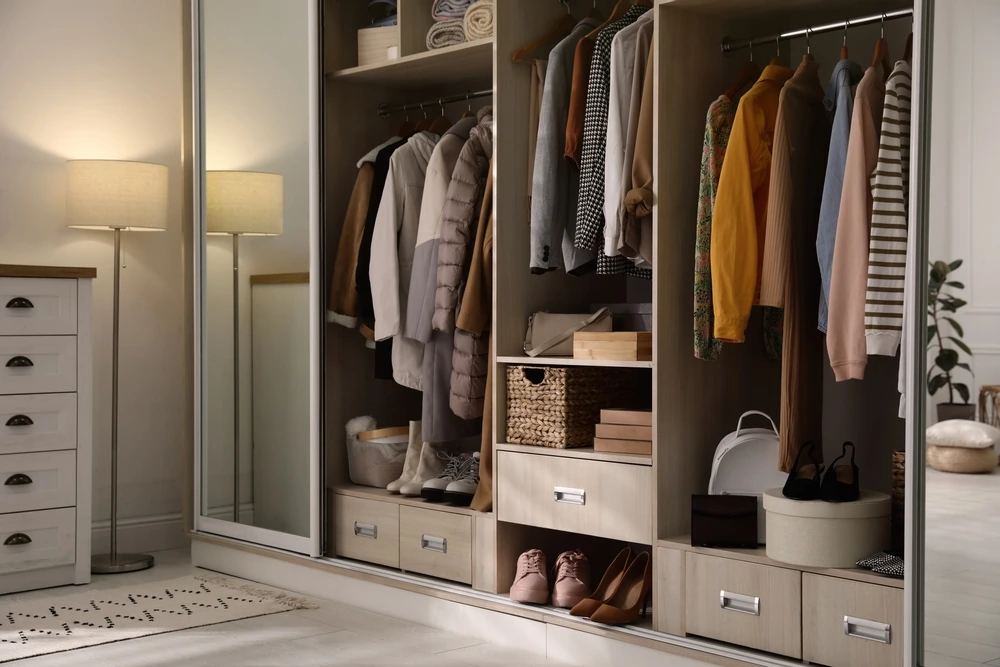
A built-in wardrobe only cuts clutter if every shelf, rail and drawer is planned around how the owner actually lives. Storage works best when it makes it easier to put things away quickly, so clothes and accessories are not left on chairs, floors or the end of the bed. The aim is to create a layout that guides daily habits rather than fights them.
To do that, the interior needs to be customised to the specific clothing mix, available space and preferred routines. That means planning hanging lengths, shelf spacing, drawer sizes and access heights in detail rather than relying on a generic layout.
Before choosing any layout, perform a clear audit of what the wardrobe must hold. This prevents overcrowding and awkward compromises later.
For most people, this means counting how many items are short-hanging, how many are long-hanging and how many are better folded. A client with mostly work shirts and folded knitwear needs different proportions than someone with long dresses and very little casual wear.
It is also important to identify non-clothing items that must live in the wardrobe. If these are not planned, they end up pushed into corners or piled on the floor. Professionals typically allocate dedicated zones for each category so everything has a defined home and is less likely to migrate into growing clutter spots.
The most common layout mistake is relying too heavily on one storage type. A wardrobe full of hanging rails wastes vertical space, while endless shelves encourage unstable stacks. The right mix is usually a combination of double-hanging, single-hanging and adjustable shelves and a few well-sized drawers.
Double hanging works best for shirts, blouses and trousers on hangers, as it doubles capacity in the same footprint. One section of single, full-height hanging should be reserved for long dresses, coats, or occasion wear to avoid crumpling hems on the wardrobe floor.
Shelves work well for bulky knits and jeans, but keep each stack no higher than 25 to 30 cm so piles do not topple. Drawers are ideal for underwear, activewear and small items that otherwise scatter across shelves. Internal dividers or shallow accessory trays keep belts, ties and jewellery contained instead of sliding around in deep drawers.
Most messy wardrobes can be traced back to a few simple layout problems. When a built-in is planned too quickly or copied from a standard design, it often ends up with wasted space, awkward access and sections that are difficult to keep organised. When the layout is tailored to the way clothing is actually stored and used, the same footprint can feel far more practical and much easier to maintain. A well-designed built-in wardrobe does more than hold clothes. It helps reduce clutter, improve daily routines and make better use of the space available.
Here at Silva Wardrobes, we believe that you shouldn't have to compromise on quality when you’re on a budget. We offer a wide range of built in wardrobe designs in varying materials and finishes, so you can get the perfect built in or walk in wardrobe for your home no matter what the budget you're working with.
Proudly Australian owned and made. All our work is carried out locally in Sydney with only the highest level of craftsmanship and comes with a lifetime guarantee.

Contact us for a free measure and quote in the Sydney metropolitan area. We send out a qualified tradesman, not just a salesman.

We then create all the components to your perfect built in wardrobe to exact specifications using only the highest quality materials

A wardrobe technician will then deliver and install your wardrobe ensuring you are 100% happy with the job before they leave.


